
A landmark event titled “Western Sahara: Self-Determination, Conflict, and the Path Forward” at the University of Sydney’s New Law School Building, brought together leading international law experts and Sahrawi representatives to assess the current state of the world’s last active decolonisation case in Africa.
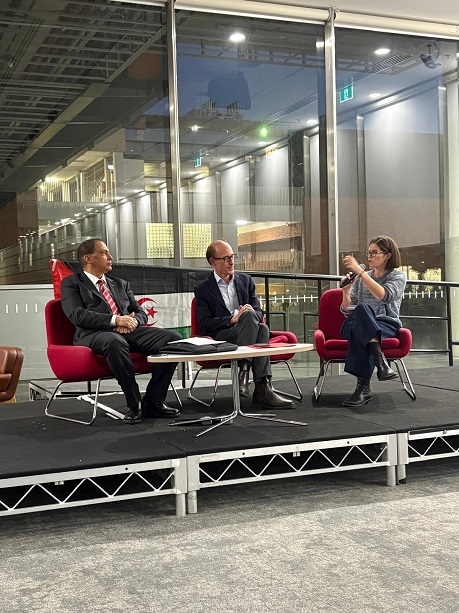
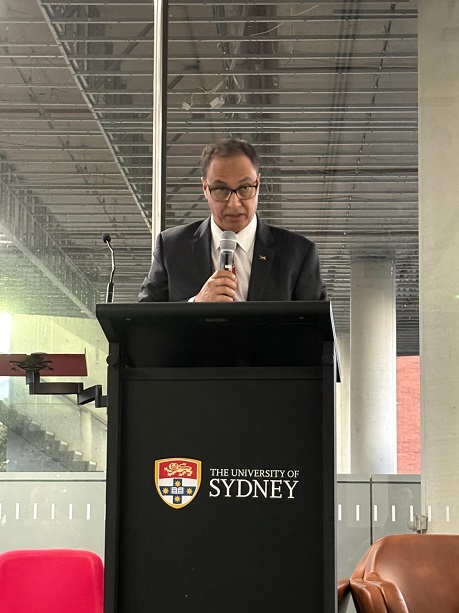
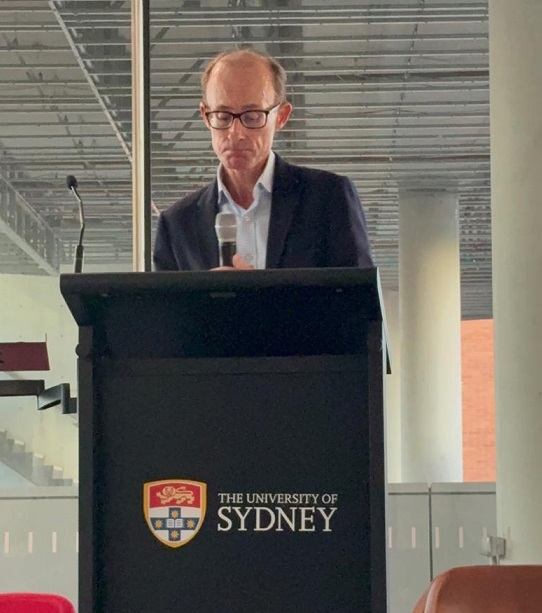
The event, sponsored by the Indigenous Studies programme (SSESW, FASS) at the University of Sydney and the Australia Western Sahara Association, drew an engaged audience to hear from Professor Ben Saul, Kamal Fadel, and panel chair Dr Randi Irwin of the University of Newcastle.
Read Professor Ben Saul’s address
Click link below for general summary of presentations and panel discussion
Professor Ben Saul: Morocco’s Occupation “Manifestly Illegal” Under International Law.
Professor Ben Saul, Challis Chair of International Law at the University of Sydney and United Nations Special Rapporteur on Human Rights and Counter-Terrorism, delivered a sweeping legal assessment of the conflict, centering his remarks on UN Security Council Resolution 2797, adopted in October of the previous year.
While acknowledging that the resolution reaffirms previous Security Council resolutions — including the commitment to a UN-supervised referendum process — Professor Saul was highly critical of its overall direction, arguing that it departs from the Council’s previously neutral stance.
“Morocco’s claim to sovereignty over Western Sahara is manifestly illegal under international law,” Professor Saul told the forum. “It violates the prohibition on the use of force and on the forcible annexation of territory, and it violates the Sahrawi people’s right of self-determination, affirmed by the International Court of Justice and the law of decolonisation.”
Professor Saul further highlighted Morocco’s transfer of its civilian population into the occupied territory as a violation of Article 49(6) of the Fourth Geneva Convention — conduct that he described as constituting a war crime under international law.
He criticised recent moves in the United States Congress to designate the Polisario Front as a terrorist organisation, calling such efforts an attempt to coerce the Sahrawi people into accepting Moroccan sovereignty. “There is no credible evidence that Polisario meets the criteria of a terrorist organisation according to international standards or United States law,” he said, noting that Polisario has never been listed by the Security Council under its counter-terrorism sanctions regime, nor sanctioned by the US, the European Union, or any other country
Kamal Fadel: Fifty Years in Exile, Still Waiting for Justice
Kamal Fadel, the Polisario Front’s Representative to Australia, addressed the human dimension of the conflict with urgency. “What we are talking about today concerns real people who have endured 50 years in exile, waiting for justice,” he told the audience.
Mr Fadel described the dire humanitarian conditions facing Sahrawi refugees in camps in southwestern Algeria, where food insecurity is worsening and the effects of climate change compound decades of hardship. He nevertheless stressed the high morale and enduring resolve of the Sahrawi people.
On the diplomatic front, Fadel reported on recent preliminary and informal talks held in Madrid and Washington — the first of their kind since Geneva in 2019 — involving senior officials from the two partiesMorocco and the Polisario as well as Mauritania, and Algeria as observers. He characterised these talks as aimed at testing intentions and re-establishing a framework for consultation, but warned that deep divergences remain. Morocco, he noted, continues to insist on its 2007 autonomy proposal as a fixed ceiling rather than a genuine basis for negotiation.
Mr Fadel reaffirmed that Polisario’s peace proposal, submitted to the UN Secretary-General in October 2025 (document S/2025/664), which offers three legitimate options — independence, integration, or autonomy — consistent with UN General Assembly resolutions 1541 and 2625. “Autonomy under occupation is not self-determination,” he said. “It is the formalisation of annexation by force.”
He also raised serious human rights concerns, noting that the occupied territories of Western Sahara remain among the most tightly controlled and underreported in the world, with independent media and human rights monitors effectively denied access. He cited documented cases of harassment, arbitrary detention, and punitive transfers of Sahrawi activists, and called on all UN bodies and international human rights organisations to intervene and protect Sahrawi civilians.
A Test for the Rules-Based Order
Both speakers concluded with a call to the international community to apply international law consistently and without exception. Comparing the Western Sahara case to the successful decolonisation of East Timor, Namibia, and Eritrea, Mr Fadel declared: “No occupation is permanent when international law is upheld and international solidarity is maintained.”
“The Sahrawi people are not asking for special treatment,” he said. “They are asking for the strict application of international law — the same right afforded to the people of Timor and Namibia.”
Professor Saul echoed these sentiments, stressing that recognition of Moroccan sovereignty by any state — including the United States — constitutes a violation of international law, as does trade in Western Sahara’s natural resources without the free and informed consent of the Sahrawi people.
The discussion concluded with a strong emphasis on the need for a fair and genuine referendum that includes the option of independence, respect for international law, and the importance of not predetermining the outcome of negotiations. The speakers called for renewed international commitment to upholding the Sahrawi people’s right to self-determination and ensuring that any resolution to the conflict is achieved through a process that is just, inclusive, and consistent with established legal principles.